
CVD Diamond Reactor Control, Monitoring & Metrology

Make long diamond-growth runs more visible, traceable and useful for process development.

Discuss a Control or Metrology Project

From Reactor Operation to Process Understanding

CVD diamond deposition may continue for many hours or days. Final wafer measurements show the outcome, but they do not always reveal when temperature drift, plasma asymmetry or thickness nonuniformity developed. Carat Systems is integrating reactor control, long-run data collection and spatial optical diagnostics to help researchers and manufacturers evaluate the complete deposition process rather than only the finished sample.

Configuration note: Available measurements, scan modes, retrofit scope and automation level depend on the reactor, sensors and process requirements. Carat reviews each integration before defining the project scope.

Current Capability Areas

The platform is structured around three practical needs: recording the run, measuring spatial behavior and modernizing controls where the existing architecture limits development.

Long-Run Process Monitoring

Time-synchronized process records can support troubleshooting, run comparison and process transfer.

  • Power, pressure, gas-flow and temperature trends
  • Recipe and run identification
  • Alarm, warning and permissive history
  • Configurable data logging and export
  • Comparison of operating behavior between runs
  • Remote diagnostic review where appropriate

Spatial Process Diagnostics

Carat already uses mapped final-wafer measurements to quantify thickness uniformity. Automated scanning is being developed to connect those final results with spatial behavior observed during the deposition process.

  • Single-point, X-line, Y-line and XY-raster scan modes
  • Spatial substrate-temperature mapping
  • Early reflectance or thickness mapping where supported
  • Growth-rate and time-dependent map development
  • Optical-emission mapping with compatible instruments
  • Correlation with process conditions and final wafer data

Existing wafer result: A published 100 mm-class, nine-location thickness map reported a mean thickness of 1.014 µm and 13.2% nonuniformity. View the thickness map and analysis.

Control & Instrument Integration

Carat can evaluate new controls or instrument integration for selected CVD research and production systems.

  • Human-machine interface and recipe functions
  • Data acquisition and device communication
  • Pyrometer, spectrometer and OES integration
  • Scanner and stage-motion integration
  • Alarm and permissive restructuring
  • Modernization of selected legacy control systems

Applications in Diamond Process Development

Control and metrology are most useful when tied to a specific growth problem. Potential applications include:

  • 100 mm wafer-scale uniformity development
  • Evaluation of high-power processing on thin wafers
  • Vacuum-chuck and substrate thermal-contact studies
  • Bias-enhanced nucleation and early interface development
  • Long-duration thick-film growth
  • Reactor geometry and plasma-position optimization
  • Correlation of in-situ data with thickness, Raman and surface measurements

Project Scope

A project may include software, controls, instrumentation, scanner hardware, process testing or a defined combination of these elements.

  • New Carat reactor configuration
  • Upgrade of an existing Carat system
  • Process-development work performed at Carat
  • Selected retrofit or modernization projects
  • Data-review and troubleshooting support

A technical review is required before Carat commits to compatibility, safety-related control changes or performance outcomes on third-party and legacy equipment.

A Diamond-Specific Development Platform

Generic HMI or SCADA programming is not the central offering. The value comes from combining control, data logging and optical measurements with practical knowledge of microwave plasma CVD diamond growth. This allows the system architecture and recorded data to be organized around process questions such as wafer temperature, growth-rate evolution, plasma symmetry, nucleation behavior and long-run stability.

The objective is to reduce dependence on isolated end-of-run measurements and make process-development decisions using a more complete record of the deposition.

Flexible Implementation

The control and metrology package can be configured around the customer's reactor and development priorities.

  • Monitoring-only upgrades
  • Scanner and sensor integration
  • New-system control configuration
  • Defined process-development programs
  • Selected modernization projects

Final functions, interfaces and deliverables are established during engineering review.
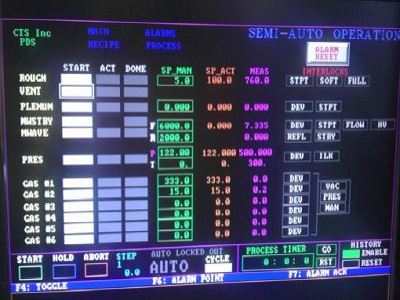
Legacy CVD reactor control interface

Selected Legacy System Support

Carat may provide limited control modifications or modernization for selected legacy Astex, Carat and customer-built CVD systems. Work is accepted only after review of the existing control architecture, available documentation, hardware condition and requested changes.

Possible work may include set-point or recipe changes, revised alarms, data logging, new instrument integration or migration to a newer control platform. Legacy Paragon support is treated as a specialized service rather than the primary focus of this page.

Discuss your reactor, measurements and process-development objectives.